Showing posts with label automotive design. Show all posts

Thursday, October 7, 2010

New Leica M9 Titanium Is Designed By Automobile Designer Walter de'Silva.


The exclusive special edition Leica M9 "Titanium" is the result of a collaboration with Walter de'Silva (shown above), a prominent automobile designer responsible for groundbreaking models from the Volkswagen Group.


The chief designer and his Audi Design Team have re-interpreted the LEICA M9 and the outcome is a special edition LEICA M9 ‘Titanium', strictly limited to 500 cameras worldwide. It is offered as a set together with a LEICA SUMMILUX-M 35mm f/1.4 ASPH. lens, whose exterior metal components are also manufactured from solid titanium.


Design & Function


Walter de'Silva has given the Leica M camera an ergonomic, precise and logical "look and feel" without changing the intrinsic character of the rangefinder camera. Thus, the compact construction and technical features of the LEICA M9 ‘Titanium' retain the distinctive style of a true Leica M camera.


The LEICA M9 "Titanium" is constructed exclusively with premium quality materials. For instance, all visible metal elements of the camera body are made from solid titanium, a particularly light but extremely strong and durable metal that can only be manufactured with special tools.


In addition, the exposed surfaces are also treated with a hard coating applied by a specialist company in Switzerland. Scratch-resistant, sapphire-crystal glass is employed as a protective cover for the camera monitor and further enhances the exclusive and rugged character of the camera.


The camera's trim, which uses leather typically reserved for the interiors of Audi's premium automobiles, fits perfectly with the body's titanium surface and provides outstanding grip. The grip characteristics are additionally enhanced by a specially designed and embossed diamond pattern.


Walter de'Silva addressed not only the design of the camera, but also focused on its handling and technical specifications. New features include the LED illumination of the bright-line frames in the viewfinder, removing the necessity for a standard illuminating window and making the front aspect of the camera even more balanced.


Furthermore, the Leica logo has been restyled and is elaborately hand-engraved in pure resin, inlaid with white enamel, sealed with clear varnish and then polished and positioned centrally - directly above the lens.

Lens with a new, focused design concept

The LEICA SUMMILUX-M 35mm f/1.4 ASPH. lens supplied with this special edition, also features a new, focussed design concept, in which the essential elements harmonise perfectly with the style of the camera.

Innovative carrying and holding concept


Instead of the traditional strap lugs of standard cameras, the chief designer and Leica engineers developed an innovative camera carrying concept that is reduced to just one single mounting point on the camera body.


Exclusive Equipment


In addition to the camera and lens, the LEICA M9 "Titanium" special-edition set includes a distinctive shoulder holster, a carrying strap and finger loops in two different sizes that are also in the same Audi premium leather as used on the camera body. Also part of the set is a book devoted to the design process leading to the creation of this high quality, special titanium edition and which also includes an interview with designer Walter de'Silva. The unique set is presented in an elaborately handcrafted black presentation case with recesses for the camera and lens lined with Alcantara microsuede in Leica red.

Price is $26,500 USD
Pre-order it here. Or here.

The LEICA M9 'Titanium' will be available starting November 2010. The UK suggested retail price of the LEICA M9 Titanium set is £19,800 including VAT.

Leica

Wednesday, October 6, 2010

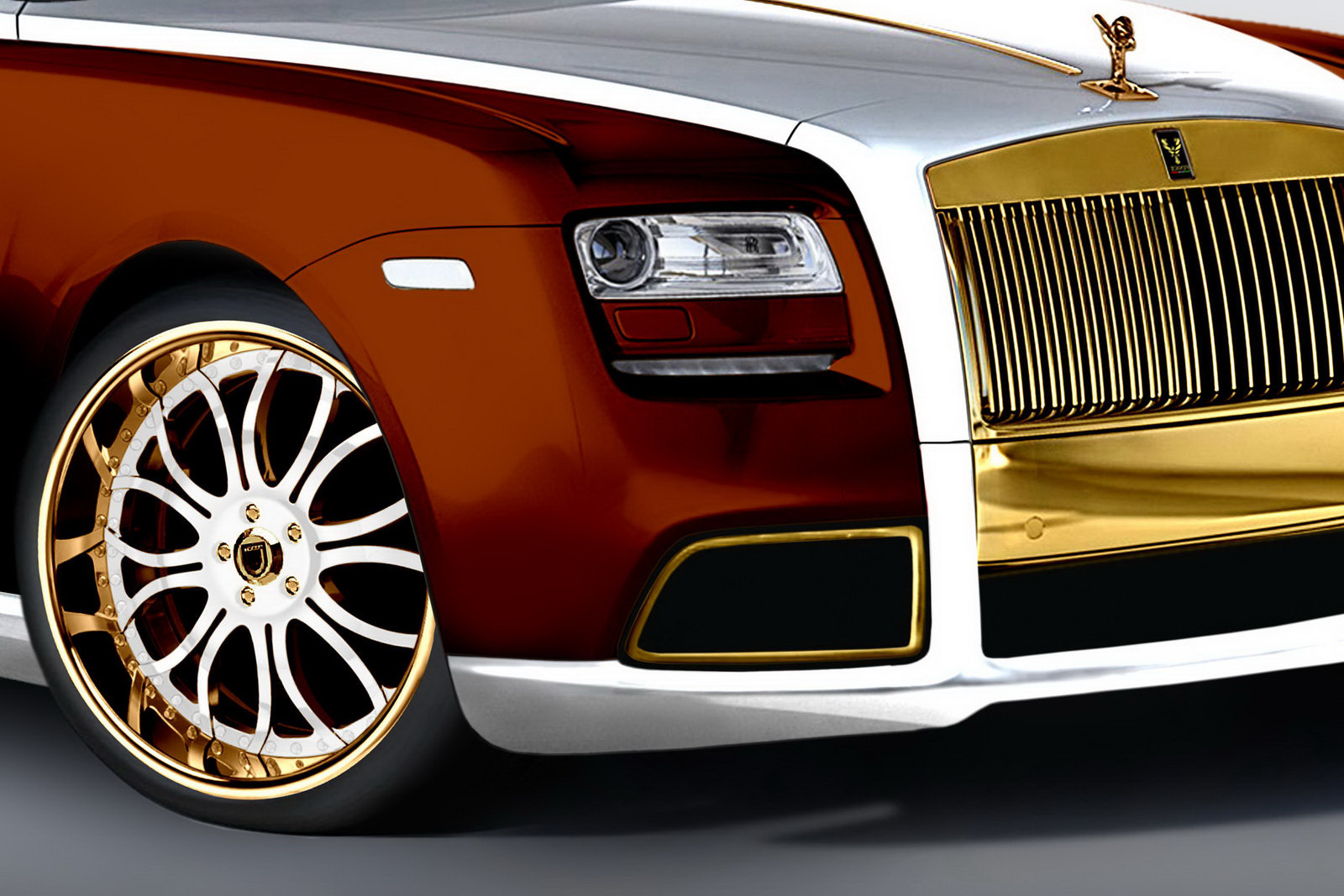
Bold, Even For A Baller. The Fenice Rolls Royce Ghost 'Diva' Has Lots Of 24k Gold.


Had I named this blog If It's Tasteful, It's Here, I wouldn't be able to bring you the news of the Limited Edition Rolls Royce Ghost 'Diva'. If you thought gold packages (the gold-plated trim option on some cars) were ostentatious, they are downright subtle in comparison to these outrageously 24k gold accented versions of the Rolls Royce Ghost, courtesy of Fenice Milan.


The luxury automobiles, available in three colors, are embellished with 24k gold grills*, hoods, window trim, side mirrors, door handles, wheels and fenders on the exterior. Inside, numerous 24k gold inserts and grey oak or teak wood can be found. Various combinations for the three colors are explained (with images) in the following press release. *The 24k gold grills, hoods and fenders are available in chromed bronze for those who, you know, want to save a few bucks.

Before going on, I felt it only fair to Rolls Royce to show you an image of the Ghost as they intended it:


the press release:
'DIVA' FENICE MILANO: ELEGANCE AND RACINESS FOR A CAR WITH A STRONG PERSONALITY


Everlasting synonym of class, elegance and perfect English style, Rolls Royce has become through the years the brand of celebrities and of all major international politicians.

In 2009, to meet the market’s modern request, the renowned English manufacturer launched the Ghost model. The 'baby' Rolls (it is only 540 cm long) has a less formal look compared to her bigger sisters, but it doesn't abandon the typical pride of the flagships boasted with the 'Spirit of Ecstasy', the famous little statue on the front. Moreover its sporty character is supported by the 12V engine 570 Hp that make of her the more powerful Rolls ever built, able to accelerate from 0 to 100 Km/h in only 4.9 seconds.

To begin with the exterior, 'Diva' is proposed in three elegant versions with a bi‐colour livery: from the classic blue-navy, to the delicious bronze and the luxury limited edition white golden pearlescent varnishing that includes particles in 24K gold.


For the navy‐blue version, the bonnet and fender are in white golden pearlescent varnishing and chromed frontal grid; while for the white version the bonnet, fender and grid are in 24K gold.


For the bronze version, instead, three combinations are available: bonnet, fender and grid in 24K gold, or bonnet and fender in white golden pearlescent varnishing and grid in 24K gold or chromed bronze grid.


Inside the console design has been maintained, but a few enhancements are provided, which due to the use of fine materials, make 'Diva' the most exclusive car available on the market. The dashboard and the passenger compartment are in biscuit‐coloured leather and wood (teak or grey oak) and include white or bronze Alcantara profiles and inserts in 24K gold, whose outlines have been hand shaped by Fenice Milano's artisans. The wheel, redesigned starting from the original one, has the crown covered in biscuit‐coloured leather and the central part in 24K gold and wood (teak or grey oak).


Below is the original, unadorned Rolls Royce Ghost driver's side interior:


Also the seats take inspiration from the original ones, but are redesigned following ergonomic principles and realized in white combined with biscuit‐coloured pure leather (alternatively a version with biscuit‐coloured pure leather coupled with bronze Alcantara seats is available), and like in the original car the picnic tables and the integrated minibar with glass holders have been maintained and realized in 24K gold.


As it happens for all Fenice Milano’s project, also for 'Diva' the aesthetic embellishments are coupled with technical interventions, able to improve the performances of the base model. The ECU upgrade, the suspensions adjustment and the optimization of the exhaust and suction system guarantee in fact notably superior performances and even more comfort onboard.

About Fenice Milano - the company bio:

Fenice Milano is a project born in 2008 from the intuition of a young entrepreneur,who decided to invest in the development of an activity in line with the tendencies of the actual market.

Symbol of freedom and independence, the car represents nowadays a mean through which we can express our individuality. In a period in which luxury is not affected by crisis and the quality of high‐end products is considered a main feature, the difference is made by personalization and by the emotions that the product is able to inspire in the person who chooses to buy it.

Strong of a thirty‐years experience in the activity of modeling and realization of special components for private and racing cars, Fenice Milano enters the market of luxury cars customization today, offering its clients the chance to make of their car a concrete realization of their personal spirit. Exactly like one chooses the furnishing for their own living room, it becomes possible to make unique a car that, although already entering the market with a high level of personalization, nonetheless suffers a natural degree of alignment caused by production in series. Trusty to the concept of an automotive 'Sartoria' (tailor in Italian), Fenice Milano doesn't produce cars, but true art oeuvres hand made by its expert artisans and 'sewn' onto the client.

An artisanal reality, where 30‐years experienced professionals work closely with young specialists interested in the new technologies and where all the processes, from the technical and stylistic project to the varnishing and the plumbing, from the disassembly to the replacement of accessories and the finishing are carried out rigorously with a particular attention to details, which make the difference.

The choice to present fine materials like gold and teak, coupled with the most innovative electronic and technical instrumentation matches the request of the markets, above all of middle‐eastern and Russian, that are always looking for products representing the best available on the market. All the projects are studied to offer different solutions that could anticipate the clients' needs, making the car of their dreams even more precious thus maintaining an elegant and refined style, immediately recognizable as Made in Italy.

After the realization of the very first project based on a Ferrari 360 Modena named 'Su Misura F101', Fenice Milano has projected many others to launch. Among these is the model 'La Dolce Vita' Fenice Milano ‐ a restyling of the new Fiat 500C born to answer the request of those who are looking for the maximum exclusivity and elegance in a "fashionable" car ‐ and 'Diva', a touch of Italian elegance and style able to make the original Rolls Royce Ghost a true masterpiece with an even stronger personality.


The 'Diva' by Fenice Milano is produced in a limited quantity (Thank God).

Sunday, April 18, 2010

Some Toy! Audi's Auto Union Type C Limited Edition Pedal Car


Pedal Car? You mean this is a 'toy'? Damn, there will be some very lucky kids out there.

This strictly limited, (999 units) hand-made edition brings back a racing legend created in a series of ten superb victories in mountain and circuit races in 1936. You'll be captivated by the model's exclusive design, exquisite craftsmanship, select materials and unparalleled attention to detail. Built at a scale of 1:2, this model is already a much sought-after collector's item.


Over 900 individual pieces were exclusively manufactured and assembled to produce this highly unusual collector's car with a chain drive. A robust aluminium tubular frame acts as the cornerstone of this eye-catching design model. The car's body - which is made of aluminium sheets - was exclusively manufactured at the Audi toolmaking division.


above: the original inspiration

The designers of this 1:2 scale model of the Auto Union Type C, of which a limited edition of 999 units are available, thought of everything to ensure maximum driving pleasure for the car's young pilots (up to 135 cm tall, or 53.1" tall) - 7-speed transmission with a back-pedal brake, hand brake lever with a locking function and hydraulic double disc brakes.


Other highlights in this intricately designed pedal car include the detachable oak wood dashboard and a leather covered steering wheel with a quick-release system for getting in and out in a flash.


Dimensions: 2020 x 968 x 624 mm
Part number: 1200700100
Price: £10,000.00 (That's about $15,618.00 USD)

To order: please contact your local Audi dealer. The Type C pedal car usually is delivered within 4 weeks of order.

Wednesday, April 7, 2010

Jeff Koons To Design the 17th Art BMW (And A Really Good Look At The Other 16)


above: Jeff Koons' concept art for the car

The New York Times announced yesterday that the next BMW art car, a long standing tradition, will be done by contemporary artist Jeff Koons.


Koon’s relationship with BMW started more than two decades ago when he first drove a BMW whilst living in Munich, home to the BMW Group headquarters. It was in 2003 that Koons first expressed his desire to create a BMW Art Car.

Frank-Peter Arndt, member of the Board of Management for the BMW AG and responsible for BMW Group’s international cultural formats, said: “We are enormously pleased about Jeff Koons’ eagerly anticipated contribution to the BMW Art Car series, celebrating its 35th anniversary. Art Cars are part of the DNA of BMW’s cultural engagement. As manifested in Koons’ latest sculptural work, what unites us is the belief that nothing is impossible. Our company and Jeff Koons are drawn to permanent innovation and cutting-edge technology.”


above: Jeff Koons (right)with celebrated architect Richard Meier (left) at the party celebrating the announcement that Jeff Koons will create the 17th BMW Art Car at Koons‘ Manhattan studio, Tuesday, February 2, 2010.

It's fairly well known that BMW has commissioned 16 Art Cars over the last four decades. The cars have toured museums around the world, including the Louvre in Paris, the Royal Academy in London, the Whitney Museum of Modern Art in New York, the Palazzo Grassi in Venice, the Powerhouse Museum in Sydney and at the Guggenheim museums in New York and Bilbao.


Four of them, by the artists Andy Warhol, Roy Lichtenstein, Frank Stella and Robert Rauschenberg, appeared at Grand Central Terminal in New York for two weeks in March of 2009. Those pieces (shown below) are part of a collection of 16 cars, from a 635CSi to an M1, that BMW has turned over to artists to re-imagine since 1975.


Andy Warhol, BMW M1 Group 4 Race Version, 1979:


Roy Lichtenstein, BMW 320i Group 5 Race Version, 1977:


Frank Stella, BMW 3.0 CSL, 1976:


Robert Rauschenberg, BMW 635 CSi, 1986:


Here are the other 12.

Alexander Calder, 3.0CSL, 1975. One of Calder’s last works, his BMW Art Car competed in the 1975 24 Hours of Le Mans:


Ernest Fuchs, 635CSi, 1982. He said his piece “represents a hare racing across a motorway at night and leaping over a burning car.”:


Ken Done, M3 Group A racing model, 1989. Along with Michael Jagamara Nelson, Mr. Done was one of two Australian artists commissioned by BMW in 1989. He painted parrots and parrot fish on his car:


Michael Jagamara Nelson, M3 Group A racing model, 1989. Using a style derived from traditional Aboriginal painting, Mr. Nelson’s work portrays a landscape as seen from the sky:


Matazo Kayama, 535i, 1990. Mr. Kayama used Japanese techniques of foil impression and metal cutting over an airbrushed surface:


Cesar Manrique, 730i, 1990. The Spanish artist and architect said he wanted his car “to appear as if it were gliding through space without encountering any form of resistance.”:


Esther Mahlangu, 525i, 1991. She painted her car in the traditional form of the Ndebele tribe of South Africa:


A. R. Penck, Z1, 1991. The German artist covered his car with pictographic images and symbols in a design that evokes primitive cave paintings:


Sandro Chia, M3 GTR, 1992. “Look at anything hard enough and it turns into a face,” said this Italian painter and sculptor of his Art Car. “And a face is a focal point of life and of the world.”:


David Hockney, 850CSi, 1995. His design offers an “inside” view of the car, including renderings of the intake manifolds painted on the hood:


Jenny Holzer, V12 LMR, 1999. Her Le Mans Roadster includes aphorisms like “The Unattainable Is Invariably Attractive.”:


Photographs © BMW AG

Left: David Hockney painting Art Car 1995, BMW 850 CSi
Right: Jenny Holzer signing Art Car 1999, BMW V12 LMR

The final and 16th art car of the series thus far; Olafur Eliasson, H2R, 2007. He turned BMW’s hydrogen-powered race car into an Art Car on ice (this one has to be kept in a refrigerated room, for obvious reasons):

The Process - Installation view Studio Olafur Eliasson, Commissioned by BMW Group:


© Olafur Eliasson and BMW Group
special thanks to BMW, Dezeen and Car Body Design and The Curated Object for additional images. and to the Los Angeles Times and Robert Peele for additional info.

Miniature replicas of all of these cars (except for the Olafur Eliasson one) are available for purchase here.


Related Posts Plugin for WordPress, Blogger...
 
Copyright © 2010 | Mixed Fashion Design | Privacy Policy